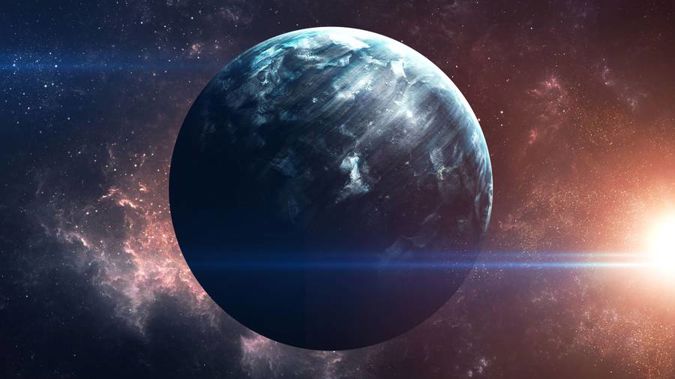
Scientists have discovered a supersized version of Earth that could host life on a distant galaxy.
The planet, named K2-18b, has been dubbed a rocky “super earth” that orbits a Sun-like star.
And it is positioned in a solar sweetspot — making it possible to host life-giving liquid water.
Researchers at the University of Texas and University
of Montreal revealed the stunning findings, that could signal a perfect
habitat for alien life.
Scientists have discovered a supersized version of Earth that could host life on a distant galaxy. The planet, named K2-18b, has been dubbed a rocky "superearth" that orbits a Sun-like star ...
First Visitor from Another Solar System Confirmed to Be Weird Cigar-shaped Asteroid -- Newsweek
The first-ever visitor to Earth's neighborhood from beyond our solar system, it turns out, looks like a giant reddish stick thrown for some cosmic dog at the park. And just a month after the weird object was spotted, astronomers have now published a paper on the discovery in the journal Nature Letters.
Wow! 1st Interstellar Asteroid Is a Spinning Space Cigar
When astronomers using the Pan-STARRS1 telescope in Hawaii spotted a mysterious object dashing through our solar system on Oct. 19, they immediately knew it was something special.
Here are the current headlines about the discovery of 20 new earth like planets that can possibly contain life. This looks like another soft disclosure attempt to seed human consciousness about life outside of our solar system. ~AscensionWithEarth.com
Conspiracy Theorists were right again, here is a collection of news reports coming out over the "discovery" of a 9th planet in our solar system. NASA finally admits to Planet X or Planet 9
Soft disclosure continues to flood the public media domain, here is a bunch of articles released by mainstream media that talks about two possible life harboring planets. One planet is only 39 light years from earth and the other is about 219 light years away. In cosmic distance, 39 and 219 light years, is like walking across the street to see your next door neighbor. What they are trying to tell the public, is that earth like planets are so common, they are literally within reach if one has capable propulsion technology. Many readers of this blog know these types of science and astronomy articles are merely soft disclosure to seed thoughts and ideas of life on other planets.
Tucked between a boiled-away desert and a giant snowball, an alien world called TRAPPIST-1e may be the only habitable planet in a newly discovered batch of seven, according to a new climate model.
When researchers announced the discovery of seven planets that closely orbit the cool red star TRAPPIST-1 in February, there was a rush to learn more about the little rocky worlds and find out if any might be habitable. One of the first scientists to model the worlds' potential climates in depth was Eric Wolf, a researcher at University of Colorado, Boulder. His model, along with others still to come, will paint a clearer picture of what the system's planets could actually be like.
Wolf modeled three planets around TRAPPIST-1 and tested different potential atmospheres to see whether any let liquid water exist on a planet's surface. He found that, in his simulation, only one of the planets listed as potentially habitable would be able to keep liquid water. [Exoplanet Tour: Meet the 7 Earth-Size Planets of TRAPPIST-1]
This may be part of the small disclosure for planet Niburu, Planet X, Sphere Being Entity of Corey Goode Fame, maybe an Andromeda Biosphere as described by Tolec? Not sure, but main stream media and main stream scientists are now reporting that they may have found another planet in our solar system and it is cloaked! Really exciting in my opinion.
~enerchi ascensionwithearth.com
*******************************************
The imagined view from "planet nine" back toward the sun.
Astronomers think the huge, distant planet is likely gaseous, similar to
Uranus and Neptune.
Caltech/R. Hurt (IPAC)
The astronomer whose work helped kick Pluto out of the pantheon of
planets says he has good reason to believe there's an undiscovered
planet bigger than Earth lurking in the distant reaches of our solar
system.
That's quite a claim, because Mike Brown of Caltech is no stranger to this part of our cosmic neighborhood. After all, he discovered Eris,
an icy world more massive than Pluto that proved our old friend wasn't
special enough to be considered a full-fledged planet. He also
introduced the world to Sedna, a first-of-its-kind dwarf planet that's so far out there, its region of space was long thought to be an empty no man's land.
Now Brown has teamed up with Caltech colleague Konstantin Batygin to do a new analysis of oddities in the orbits of small, icy bodies out beyond Neptune. In their report published Wednesday in The Astronomical Journal,
the researchers say it looks like the orbits are all being affected by
the presence of an unseen planet that's about 10 times more massive than
Earth — the size astronomers refer to as a super-Earth.
New Planet Discovered by NASA; Kepler-22b Might Support Life
December 06, 2011
Space Telescope Spots 'Earth-Like' Planet 600 Light Years Away
Jessica Berman
Photo: NASA
This artist's conception illustrates Kepler-22b, a planet known to comfortably circle in the habitable zone of a sun-like star. It is the first planet that NASA's Kepler mission has confirmed to orbit in a star's habitable zone - the region around a star where liquid water, a requirement for life on Earth, could persist. The planet is 2.4 times the size of Earth, making it the smallest yet found to orbit in the middle of the habitable zone of a star like our sun. Scientists do not yet know if the planet has a predominantly rocky, gaseous or liquid composition. It's possible that the world would have clouds in its atmosphere, as depicted here in the artist's interpretation.
Astronomers working with NASA's orbiting Kepler space telescope say they have discovered the smallest and most Earth-like planet ever seen outside our solar system. They say it orbits a sun-like star in the so-called “habitable zone” - a distance from the parent star where moderate temperatures on the planet would make liquid water - and life - possible.
The newly found planet, named Kepler-22b - is one of a growing inventory of nearly 50 newly discovered super-Earth planets orbiting neither too close nor too far from their parent stars and where conditions might exist that could support life.
Kepler-22b is 600 light years away - meaning it would take a light beam from Earth 600 years to reach it. But even at that enormous distance, the Kepler astronomers were able to discern that the planet is about 2.4 times the diameter of Earth, orbits its sun in an Earth-year-like 290 days, and because of its mid-range location in the "habitable zone," probably enjoys balmy daytime temperatures of around 22 degrees Celsius.
But Jon Jenkins, co-investigator for data analysis with the Kepler mission, says it is not yet known whether the surface of Kepler-22b is rocky like Earth and could actually support life.
“Although this planet is over twice the size of the Earth, if it were indeed rocky, you could have liquid water pooling on the surface," said Jenkins. "And as far as we know, liquid water is required by all life that we know about. So, it’s an incredibly necessary ingredient for life as we know it.”
Kepler-22b has been formally confirmed by other telescopes. The Kepler team says it has discovered nearly 1,100 candidate exoplanets with the aid of the sharp-eyed space telescope.
Kepler is currently scanning a narrow segment of the cosmos, continuously observing an estimated 150,000 stars within the segment for orbiting planets.
Jon Jenkins says he is thrilled by the discovery of Kepler-22b, after years of searching for Earth-like planets.
“It’s great to be at this point where we have this milestone of finding this first super-Earth planet in the habitable zone of a sun-like star," he said.
Jenkins says it will be up to future missions and more powerful telescopes to determine if there actually is life on Kepler-22b and the other exoplanets, but Jenkins says as more data is gathered on these distant worlds, life beyond Earth seems increasingly in the realm of possibility.